

What’s Your Problem?!
Solving challenges using design thinking.
By Wendy Puffer
Have you ever witnessed the life drain from a room during a strategic planning session? Ambition gives way to apathy, excitement to exhaustion. The audience pleads silently, their body language begging for release, while the speaker drones on, oblivious. This disconnect—the speaker’s lack of awareness of the audience’s disengagement—highlights a critical problem: When we’re left to our own devices in ideation, we often get stuck, trapped by existing solutions and blind to the deeper human needs that drive innovation.
Design Thinking offers a lifeline. It is a human-centered problem-solving approach that emphasizes empathy, creativity, and iteration. It involves understanding user needs, defining challenges, brainstorming ideas, prototyping solutions, and testing them in real-world contexts. Design thinking takes the bore out of problem solving with an iterative, playful, and team-centered approach to innovation. And it empowers leaders and teams to engage the client in a divergent and convergent process.
As a design professor at Indiana Wesleyan University in Marion, Indiana, and co-founder of Marion Design Co., I saw the rise of Design Thinking as a game changer and wanted to know more. So, I pursued an MFA in Design Thinking while teaching undergraduates. This allowed me to apply the strategy’s empathetic principles to my teaching and community work. At a time when IDEO, a global design and consulting firm known for pioneering human-centered design and design thinking, was bringing design thinking to the forefront for product design, I was captivated by its core principle of “fail faster, cheaper.” This framework champions action over reaction, courage over hesitancy. It espouses that early prototyping minimizes the cost of failure. I actively cultivated this ethos in my teaching, encouraging students to embrace failure as a springboard for innovation.
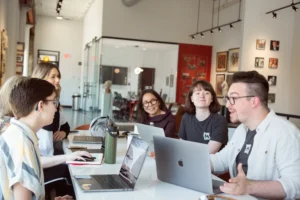
A unique opportunity arose in 2016 when the Mayor of Marion, Indiana, challenged the design professors at our university to rebrand the city. Marion felt worlds apart from our thriving campus. The city was struggling with the decline of businesses, resulting in empty storefronts on the downtown square. We seized the challenge. Two faculty colleagues and I assembled a team of 17 design students who agreed to work for free, for the summer, in the heart of downtown. The county provided us with a temporary space in a vacant bank on the downtown square, and we transformed it into a design studio. Our first project was to interview hundreds of community members, asking one question: “What are words that describe Marion to you?” Participants scribbled these on sticky notes, which then filled the glass walls of the bank.
The students, fueled by passion and a shared purpose, uncovered a surprising truth: Marion, despite its struggles, possessed incredible potential. They articulated this in a powerful problem statement: “Marion is a full and capable community, but it’s misperceived, segmented, and under-realized.”
Marion had seen countless revitalization attempts falter. Grants had been written, projects launched, but enthusiasm fizzled each time. These efforts often rested on assumptions about what the community needed, rather than truly understanding its unique challenges. Copying successful models from other towns simply didn’t work. Design Thinking, with its emphasis on empathy, provided a crucial shift in our project. We recognized that the problem wasn’t a lack of resources but a lack of self-belief. Marion, we discovered, suffered from low self-esteem, struggling to overcome internal barriers to success. This project, therefore, transcended a simple rebranding. It ignited a spark of revitalization, empowering the community to identify its own strengths and work towards a brighter future which was reflected in the new brand identity we created for the city. As a result, investors began purchasing buildings and launching new businesses. Organizations that previously were siloed began working together to accomplish innovative solutions in collaboration.
While Marion Design Co. was originally launched as a summer project, we discovered that the city needed us to sustain the efforts we had started. So, we became a business, reinforcing the importance of long-term investments in Marion.
DESIGN THINKING FOR PUBLISHERS
Design Thinking offers a powerful framework for identifying and solving problems, regardless of your profession. Since 2016, my design firm has successfully applied Design Thinking to diverse sectors, from healthcare and education to faith-based organizations and beyond, and with a range of groups, from individuals to large teams.
The publishing industry faces its own unique set of challenges, both internal and external. Whether you’re concerned about reader engagement, the creative process, or the evolving business landscape, you likely grapple with persistent questions, such as:
- What stories are your readers desperate to hear?
- What’s hindering your creative flow?
- What are the most frustrating aspects of the publishing process?
- How can technology enhance your reach and impact?
By framing these challenges as questions, we unlock a powerful shift in perspective. Instead of dwelling on frustrations, we actively engage our curiosity and begin to explore the inherent assets that reside within the problem itself. How might we tackle the problem you’re facing by utilizing a design thinking method developed for asset discovery? In our Marion city project, the initial lack of a permanent studio space presented a significant challenge. We had been in the bank space for two years when the county decided to transform it into the new dispatch center, leaving us homeless. For a while, we were constantly on the move, searching for our next temporary location. However, this very challenge unexpectedly revealed a valuable asset: the energy and enthusiasm of our college students.
Wherever we set up shop, a surge of youthful energy transformed the surrounding area. The vacant storefronts we utilized, once lifeless, came alive with student activity. This dynamic presence attracted attention, leading to the establishment of new businesses—a call center, a thriving retail shop, an event rental space—in the wake of our temporary residencies. We inadvertently became catalysts for revitalization, breathing life back into neglected corners of the city.
This experience underscored a crucial principle: Valuable assets often lie hidden within the challenges we face. By embracing the constraints of our situation, we unlocked a hidden asset—the vibrant energy of our students—that contributed to the very project we were working on. For our first six years, we moved to four different temporary locations, sparking new innovation as our students brought life to these blighted spaces. Even now, after two years in a permanent space inside the Kennedy Art Center, our student interns bring youthful energy as we continue to work on revitalizing the city.
REALIZE YOUR ASSETS
Over our almost-10 years using this approach, Marion Design Co. has developed a design thinking tool that helps uncover hidden assets within a set of challenges. We call it, “What’s Your Problem?”
Whether the challenge is personal or professional, this tool enables you to reframe what’s available inside the problem for helping to solve the problem in a meaningful way. Instead of focusing solely on deficiencies, this approach encourages us to delve deeper and uncover valuable assets that often lie dormant within the problem itself.
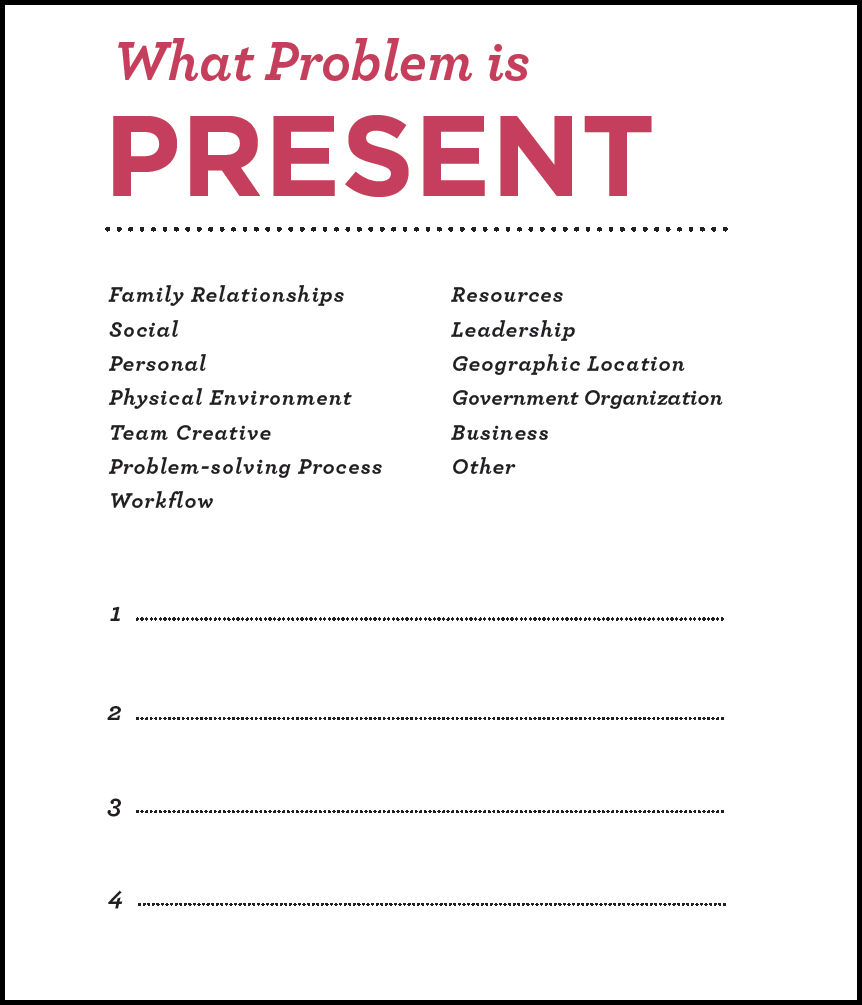
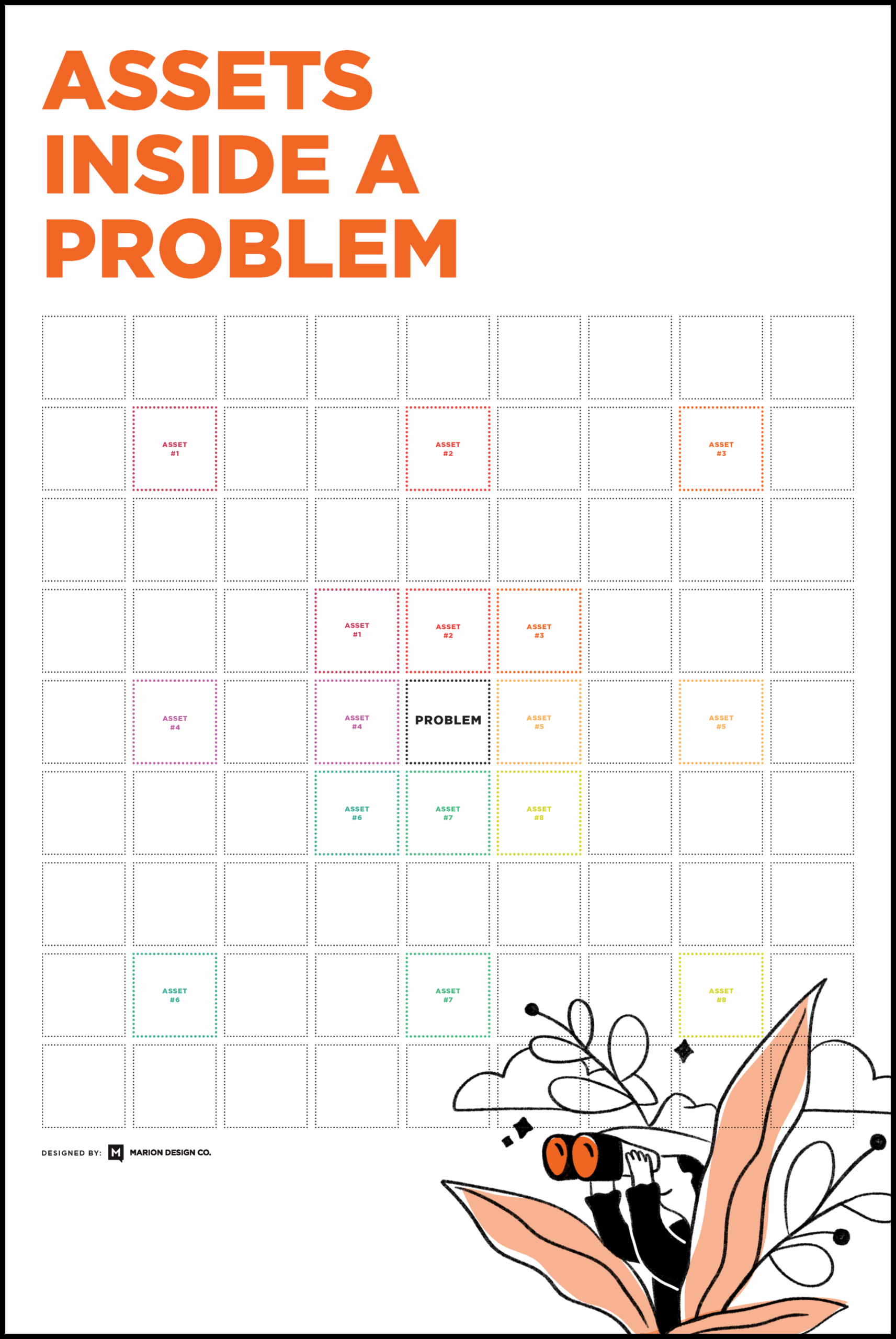
The process begins with stating the problem at hand. In our tool, space is provided (see What Problem Is Present) to write several problems you’re currently facing. Select a single one you want to tackle from the list you’ve created and move on to the Asset Finder Grid (see Assets Inside a Problem, below).
Click to enlarge
How to Use the Asset Finder Grid:
- Identify the Problem: In the center of the map, clearly and concisely state the problem you’re facing. Example: “Declining readership and engagement with a traditional print publication.”
- Uncover Hidden Assets: Radiating outwards from the central problem, identify at least eight different assets that exist within the problem itself. These assets can be anything: skills, resources, existing relationships, untapped potential. Even the problem itself can be an asset in disguise!
Here are eight potential assets that might be found within this problem:
- Loyal Subscribers
- Strong Brand Heritage
- Experienced Team
- Existing Distribution
- High-Quality Archives
- Unique Niche Focus
- Community Connections
- Brand Loyalty
Write each asset in a colored square. Once all eight squares are filled in, write each asset again in the corresponding colored square located farther out in the grid. (Tip: I recommend writing the ideas on small Post-it notes; they’ll be used in the next activity.) In the space surrounding each color, write eight distinct ideas for how to leverage that asset to address the problem of declining readership and engagement with a traditional print publication. Here’s an example:
- Create a subscriber loyalty program with exclusive benefits.
- Launch a “refer-a-friend” program to incentivize subscriber growth.
- Host subscriber-only events and workshops.
- Feature subscriber stories and testimonials in the publication.
- Create a dedicated online community forum for subscribers.
- Offer subscriber discounts on merchandise and events.
- Conduct subscriber surveys to gather valuable feedback and insights.
- Partner with subscribers on co-created content initiatives.
Click to enlarge
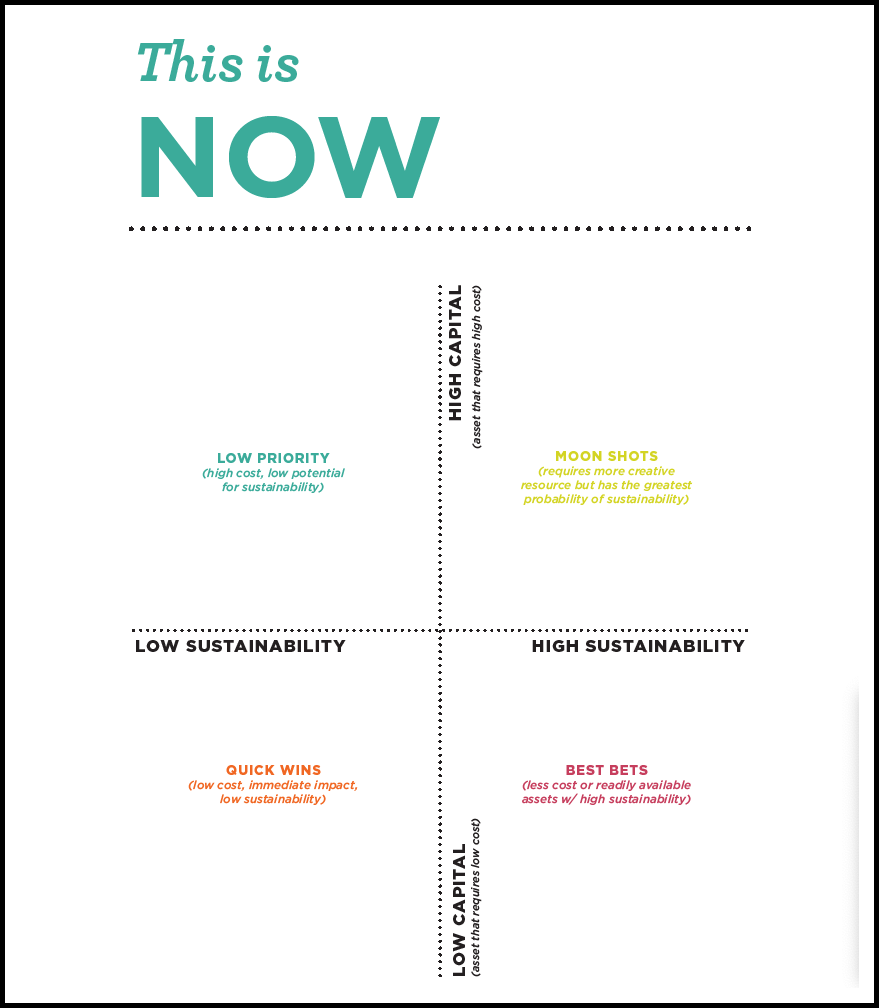
Once the Asset Finder Grid is complete, you will have 64 ideas from the assets inside the problem. You’ve just completed the divergent process of design thinking. That is, diverging from the core challenge in order to gather as many ideas as possible in a short amount of time. This brainstorming process is best completed within a short time constraint to avoid overthinking an idea to death. Now that you have a ton ideas from which to launch, let’s examine them to better understand each idea’s needs, sustainability, and effectiveness. The Asset Opportunity Map (See This Is Now) is designed to do just that.
The goal of this map is to identify, for each Asset Finder Grid idea, its sustainability and the capital it may require to implement. Moving from one cluster of ideas to the next, remove the Post-it notes and place them on the opportunity map. As you do, consider the following aspects of sustainability and capital. An idea’s sustainability hinges on its ability to endure. Economic sustainability ensures profitability, while environmental sustainability minimizes impact. Social sustainability considers community impact and equity. Technological sustainability ensures adaptability in a changing world. Cultural sustainability respects existing values and norms. Finally, ethical sustainability ensures the idea aligns with ethical principles. Capital for publishers may include financial capital that funds operations and human capital, which is your skilled workforce. Social capital stems from author relationships and audience connections. Intellectual capital resides in the publication’s unique voice, archives, and innovative ideas. Cultural capital lies in the idea’s ability to shape and reflect the cultural landscape.
Click to enlarge
Once the 64 ideas are plotted on the map, step back and analyze the patterns that emerge. Avoid immediate judgment. Observe if any areas of the map are more densely populated with ideas. Understand that no idea is inherently “bad.” Subsequent evaluation will reveal that each solution requires varying levels of time and financial investment. Moreover, ideas with shorter sustainability may still possess significant value when implemented strategically and with appropriate expectations, recognizing their role in contributing to longer-term, more sustainable solutions. This pulling together of ideas is the convergent part of the process.
This series of activities may be used multiple times for a variety of problems or multiple times for the same problem. It is designed to help the participants dig deep and trust their intuition as they collaboratively work to solve important problems. The key is to approach each problem with curiosity. By identifying and leveraging these hidden assets, we can transform seemingly insurmountable challenges into opportunities for growth and positive change.
For Marion Design Co., discovering the multitude of assets inside the problem of moving from one temporary location to another freed us to help accelerate the impact that student energy brought to each location. As we met with building owners and asked them to consider allowing us to work from their space, we were able to share with them the benefits we could bring to their business and location. This newfound understanding empowered us to tackle critical challenges with renewed confidence and a more strategic approach.
Wendy Puffer is the co-founder and owner of Marion Design Co., and Director of the Kennedy Art Center. She’s a mid-century modern enthusiast who renovated her family’s A-framed home and filled it with her favorite Eames, Saarinan, and Knoll furniture.
Email us at info@lanepress.com, and we’ll send you the full-size file for the Asset Finder Grid, Assets Inside a Problem.